Healing hearts, honest AI, a livable planet. Thirteen research loops, built in one day.
Behind every open science problem is someone it could help: a patient, a family choosing a home, a person trusting an AI's answer.
Scientists brought the open problems from their own research that they most wanted AI help with.
They teamed up with AI engineers and spent a day building research loops:
agents that read the literature, write and run code, and check their own results.
Every loop is on GitHub, under an open license, for anyone to keep running.
7 November 2026
CIC Berlin
A Claude Community Berlin event, co-hosted by Foresight Institute's Berlin AI Node
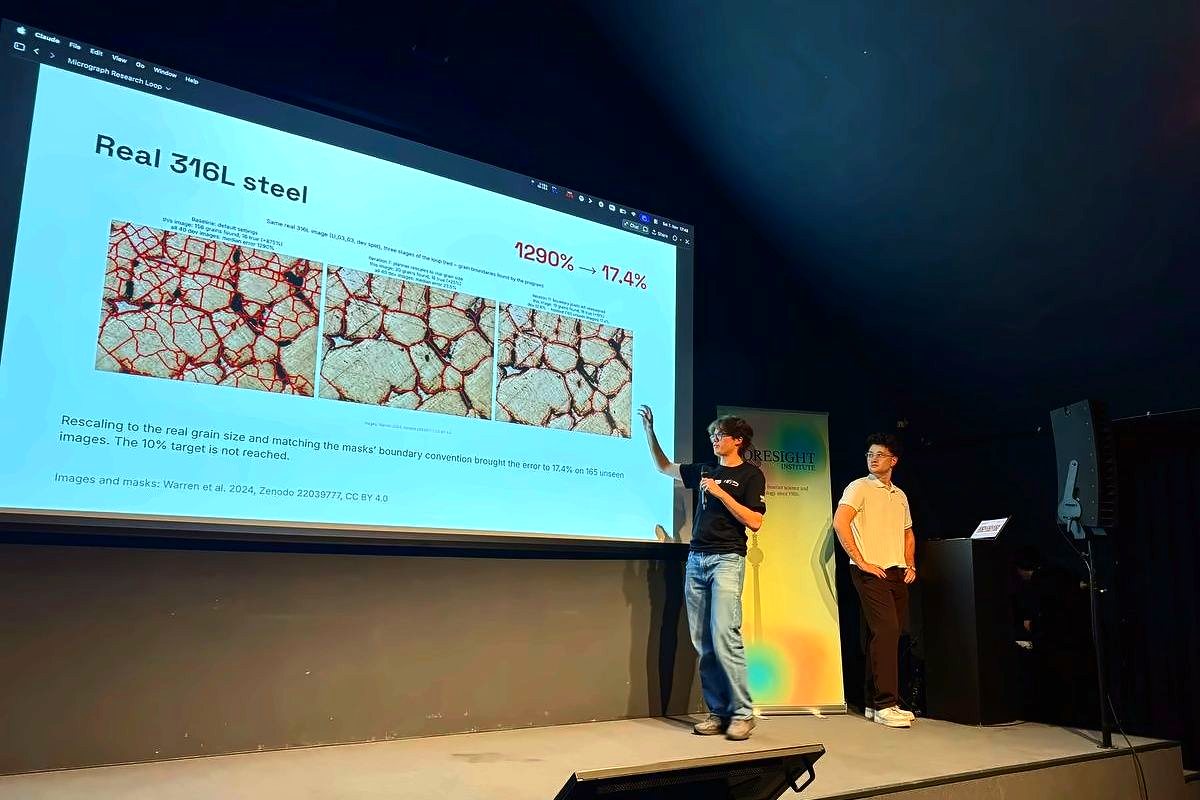
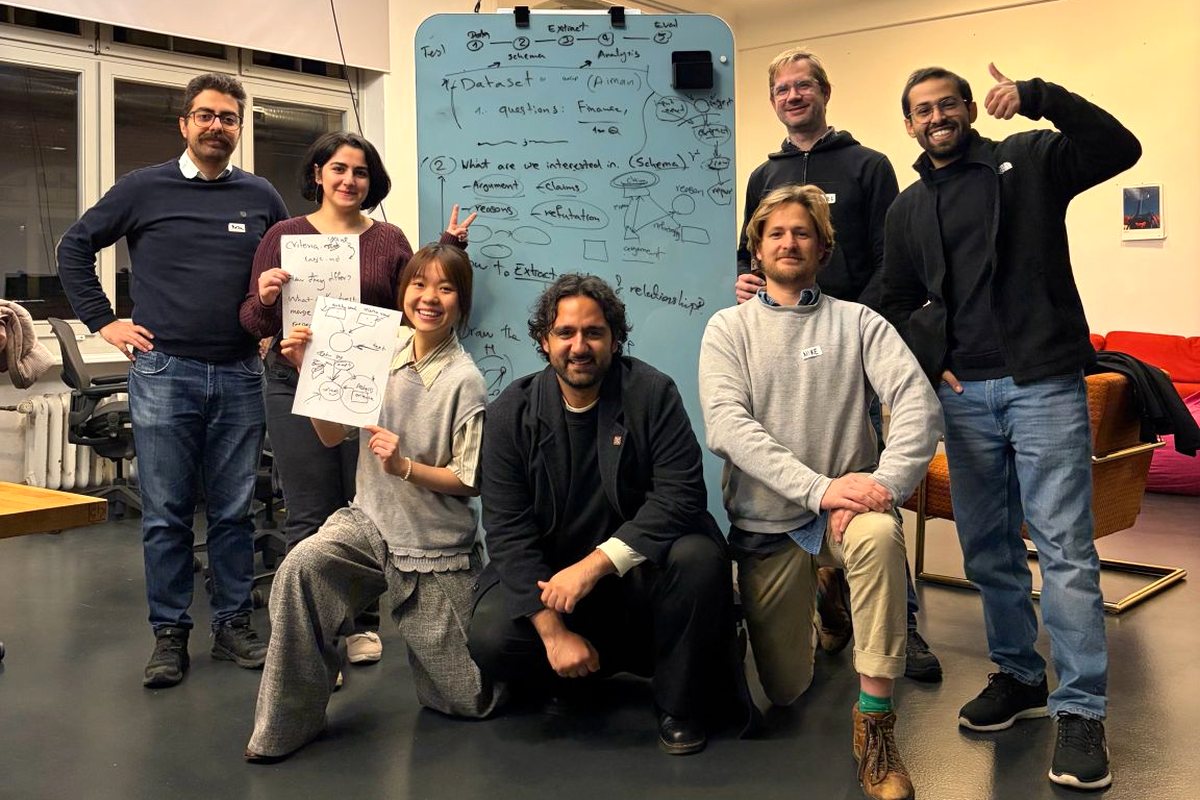
micrograph presents its loop: on real steel, the grain-boundary error falls from 1290% to 17.4%.The Do LLMs Argue Like Humans? team in front of its plan: extract arguments, claims, reasons and refutations, then compare them.
1 / 2
13research loops, each in a public GitHub repository
4human goals: healthier lives, AI people can trust, a safer society, a livable planet
11projects whose results recompute exactly from their committed files or public data
7projects that report a negative result or a missed target in plain words
Why it matters
Behind every problem, a reason to care
Each loop works on a narrow, checkable question.
Each question sits on a road that ends in people’s lives: a heart that heals, an AI answer you can rely on, a home that is good for the planet.
Below, the goal that makes each problem worth solving, and how far one day got toward it, so you can judge the potential and the progress separately.
In July 2026, Foresight Institute brought researchers and builders to Berlin for its
Secure & Sovereign AI Workshop.
In one of its working groups, two of this lab's organisers, Keith Patarroyo and Kazik Pogoda, started from a simple observation:
AI research loops can already automate real parts of scientific research.
So which research should we automate first?
We realised we could not answer that ourselves.
Choosing well means knowing where a field is stuck, which results can be checked, and what a breakthrough would change for people.
That knowledge belongs to the scientists who do the research.
Meanwhile, the know-how of building loops grew up in computer science and machine learning,
and has barely reached the labs working on hearts, materials or the climate.
Each side holds half of the answer.
So instead of guessing, we pitched a way to find out:
an Impact Lab that puts domain scientists and AI engineers side by side, on problems the scientists bring.
The scientists see what a loop can do with their own question;
the engineers learn what a problem worth solving looks like;
and the open loops they build together show, one field at a time, where automating research pays off first.
July 2026 · Foresight InstituteThe question and the pitchA working group at the Secure & Sovereign AI Workshop asks which research to automate first, and proposes bringing scientists and loop engineers together to answer it.
4 November 2026 · Claude ConversationScientists name the problemsAn evening at CIC Berlin on where AI already helps research, where it fails, and which open problems scientists most want help with.
7 November 2026 · Claude Impact LabThirteen loops in one dayScientists and engineers built open research loops on those problems. This page is the first answer to the question from July.
The format
A scientist's open problem, an engineer's loop, one day
An Impact Lab is not a hackathon for demos.
The scientist owns the question and judges the answers;
the engineer builds the loop that keeps Claude working on it.
The loop only starts to produce value when the two work side by side.
Real, open problemsQuestions the scientists are stuck on in their own research, checkable by computation.
Loops, not chatsAgents that read, write code, run it and check themselves, keeping their state in files so any new session can continue.
Open by defaultApache 2.0 for code, CC BY 4.0 for text, donated to Foresight Institute so the work outlives the day.
Show where it got stuckEvery team reports what it found, where it failed and what it would need next. Honest negatives count.
Bring a problemScientists apply with an open question from their own work.
Form a teamEach problem attracts AI engineers; the scientist stays the problem owner.
Build the loopClaude Code with /goal and /loop, state in files, tests first.
Publish and submitA public repository and a structured submission issue with links to evidence.
Assessed in the openEvery claim checked against the repository; assessments published.
Keep it runningOpen-licensed, donated to Foresight Institute, ready for anyone to continue.
Results
What the loops found in one day
A selection of results, each traced to files in the team's repository and checked in its published assessment.
Some are discoveries; some are well-verified "no"s, which are just as useful to the next researcher.
Each card links to the open-source repository, the team's submission, and Claude's published assessment of it.
Every project page can be shared by its own link.
The judging panel chose Shift Happens as the winning project.
Blockchain forensics#3
ChainSentinel
Recovering FBI-listed laundering addresses of the Binance theft from 20% seeds
Why it matters
Following stolen money, in the open. Crypto thefts move billions into crime, and tracing them relies mostly on closed commercial tools. Open, explainable methods let researchers, smaller exchanges and the public check the work.
The question
Can open, explainable rules recover the Ethereum addresses the FBI tied to a major exchange theft, given only a fifth of them?
What it found
The best rules put 49 FBI-listed addresses in the top 50 and reach 343 of 486 held-out addresses (71%). An independent reimplementation reproduced the ranking exactly.
Where it got stuck
The literature step was never used, and the FBI list itself comes from investigators' tracing, so the scores measure agreement with them, not new discovery.
Assessment scores
ProblemLoopEvidenceHonestyReproducibilityFrom Claude's published assessment, 1–5 per criterion. Not a ranking.
Agents build the SSH mapper: differential state machine learning of 12 implementations
Why it matters
Safer digital infrastructure. SSH is how the world’s servers, routers and devices are run, yet many lesser-known implementations are rarely audited. Agent-built testing could check every one of them.
The question
Can agents build the protocol “mapper” that state-machine learning needs, a step that usually costs experts weeks per implementation?
What it found
An agent-built SSH mapper reached 12 servers in a day and matched the published harness on the three they share. The pipeline found an RFC 4253 §7.1 violation still present in wolfSSH, backed by packet traces.
Where it got stuck
Two targets never converged, the input alphabet covers only password login and one cipher, and the candidate findings await confirmation by maintainers.
Assessment scores
ProblemLoopEvidenceHonestyReproducibilityFrom Claude's published assessment, 1–5 per criterion. Not a ranking.
An agent loop that tunes classical grain segmentation on optical micrographs of metals
Why it matters
Stronger steel, checked faster. Grain size decides how strong and durable a metal is, from bridges to medical implants. Measuring it is still slow, manual work in materials labs.
The question
Can an agent tune an explainable, classical pipeline to measure grain size in steel micrographs against expert masks?
What it found
Error on the development set fell from 1290% to 12.6%, and to 17.4% on 165 unseen images. Every number recomputed exactly from the public 316L dataset.
Where it got stuck
It misses its own 10% target, as the team says: one global scale cannot fit fine- and coarse-grained images, and the literature step worked mostly from memory.
Assessment scores
ProblemLoopEvidenceHonestyReproducibilityFrom Claude's published assessment, 1–5 per criterion. Not a ranking.
Searching for a model organism of sneaky reward hacking
Why it matters
AI that can’t cheat in secret. AI systems now write code and run tasks for millions of people. We need to see when a model games its goals, before models learn to hide it.
The question
Is there a small open model that cheats on its tests in a way a monitor cannot see in the code, but can see in its chain of thought?
What it found
Never told to cheat, Qwen3-8B wrote a planted mutant test's behaviour in 17% of samples, against 0–1% in two controls. Labels come from running the code, not from a judge.
Where it got stuck
A same-size monitor that is allowed to think still catches 60–87% of the hacks, no setup passes every criterion at 95% confidence, and the behaviour is prompted, not trained.
Assessment scores
ProblemLoopEvidenceHonestyReproducibilityFrom Claude's published assessment, 1–5 per criterion. Not a ranking.
A wider lens on material use in sustainability and well-being
Why it matters
Homes good for people and the planet. Buildings are among the largest sources of greenhouse gases, and Germany asks for their life-cycle emissions from 2027. Architects need honest comparisons early, while materials are still being chosen.
The question
How do structural systems for German housing compare on life-cycle carbon, moisture safety and disassembly, with the system boundary stated?
What it found
Timber frame with straw infill and clay plaster ranked first, with the lowest life-cycle carbon at 140 kgCO₂e/m². Along the way the team found reference-unit errors in the Ökobaudat database itself.
Where it got stuck
The ranking rests mostly on assumed property values and moves with the model, the source export is not committed, and the two loops are not yet connected.
Assessment scores
ProblemLoopEvidenceHonestyReproducibilityFrom Claude's published assessment, 1–5 per criterion. Not a ranking.
Calcium sleep reactivation toolbox: four methods, one locked answer key
Why it matters
How sleep keeps our memories. During sleep, the brain replays the day to store it. Watching that happen in thousands of cells at once could help explain memory loss in ageing and disease.
The question
Are the standard methods for detecting memory reactivation in sleep, built for electrode spikes, valid on slow calcium-imaging data?
What it found
With the verdict rule locked before any real data, the toolbox detects known reactivation in rat recordings and returns “not enough evidence” on the public mouse calcium session. Every key number recomputed from the raw public data.
Where it got stuck
Two of the four methods fail their own controls, and there is no public calcium dataset yet with learning between sleep bouts to serve as a true positive.
Assessment scores
ProblemLoopEvidenceHonestyReproducibilityFrom Claude's published assessment, 1–5 per criterion. Not a ranking.
An agent that checks itself when cell states have no ground truth
Why it matters
Hearts that heal themselves. A zebrafish regrows its heart muscle after an injury; a human heart scars after a heart attack. Knowing which cells do the healing is a step toward therapies that help human hearts repair themselves.
The question
How do you trust an agent's cell-state annotation of the regenerating zebrafish heart when no ground truth exists? Score its checks, by planting defects.
What it found
Published border-zone and injury markers mostly mark the atrium, and inside the ventricle three of the four “states” collapse into one nppa/nppb program, across eight reviewed cycles.
Where it got stuck
The analyses need a processed data file that is not public, the real-data diagnoses come from one dataset, and the comparison with expert labels is still to come.
Assessment scores
ProblemLoopEvidenceHonestyReproducibilityFrom Claude's published assessment, 1–5 per criterion. Not a ranking.
Three AI-agent approaches to speaker profiling, and how far to trust them
Why it matters
Privacy for people who share their stories. People who give interviews to researchers are promised anonymity. Knowing how much a “blinded” transcript still reveals lets archives protect them and stay open to research.
The question
How much do “blinded” interview transcripts still reveal about who is speaking?
What it found
On the ESLO corpus of Orléans interviews, a quote-grounded loop recovered speakers' sex and recording era in all 99 interviews it completed, and age bracket exactly in 59 of 68.
Where it got stuck
Two of the three approaches are not in the repository yet, the held-out interviews have not been run, and the corpus quotes need a licensing fix.
Assessment scores
ProblemLoopEvidenceHonestyReproducibilityFrom Claude's published assessment, 1–5 per criterion. Not a ranking.
An agent that screens protein domains against human metabolites
Why it matters
Watching metabolism in living cells. Biosensors that light up when a metabolite appears let labs follow metabolism live, in diabetes, cancer and the microbes that make medicines. Today, finding one for a new molecule takes a structural-biology budget.
The question
Which protein domains could sense a given human metabolite, so that a lab without a structural biology budget can start a biosensor project?
What it found
A three-stage screening funnel (bindPredict, PSICHIC, DiffDock) with carefully designed safeguards, and a curated table of 8,685 protein–ligand pairs that makes a scored evaluation possible.
Where it got stuck
No screen has run yet: the ligand library, the tool environments and a pilot run are the next steps, and the fuller code sits on an unmerged branch.
Assessment scores
ProblemLoopEvidenceHonestyReproducibilityFrom Claude's published assessment, 1–5 per criterion. Not a ranking.
Blind researcher agents and review panels scored against psychology replications
Why it matters
Science we can rely on. Many published findings fail to replicate, which misleads medicine and policy. As AI multiplies claims, we need review that reliably lands on the truth.
The question
Which social structure of peer review lands on the truth most often, scored against real replication outcomes?
What it found
Blind researcher agents, given masked study cards and raw replication data, reached the recorded conclusion on all 30 Reproducibility Project studies.
Where it got stuck
The review panels, the actual research question, have not run yet; the cards named the test to run, and the studies are likely in the model's memory.
Assessment scores
ProblemLoopEvidenceHonestyReproducibilityFrom Claude's published assessment, 1–5 per criterion. Not a ranking.
Comparing the reasoning graphs of human and ChatGPT answers
Why it matters
Keeping our reasoning rich. More and more people learn and decide with AI answers. If those answers skip the counterarguments, how we reason together gets flatter.
The question
Do ChatGPT answers build their arguments differently from human ones, seen as graphs of claims and links?
What it found
A careful extraction study: voting over five labellings makes LLM argument extraction much more stable on short texts, at no loss of accuracy. Its numbers recompute exactly.
Where it got stuck
The human-versus-LLM comparison itself is not yet committed in a checkable form, and hand labels are needed to know the extractor reads both kinds of text equally well.
Assessment scores
ProblemLoopEvidenceHonestyReproducibilityFrom Claude's published assessment, 1–5 per criterion. Not a ranking.
Lie detectors that generalize to unseen kinds of lies
Why it matters
Knowing when an AI is lying. A lie detector for AI only helps if it catches lies it has never seen. That is what would let people rely on what a model tells them.
The question
Do activation lie detectors catch kinds of lies they were never trained on, as a real deception monitor must?
What it found
Claude rewrote the probe 15 times against a harness that hides the test families, raising test macro-AUROC from 0.806 to 0.845. Editing a probe's weights directly did not survive the sealed test, a clean negative result.
Where it got stuck
One seed and a gain of about two standard errors; the activations and per-example scores stayed in Colab, so the results rest on committed summaries.
Assessment scores
ProblemLoopEvidenceHonestyReproducibilityFrom Claude's published assessment, 1–5 per criterion. Not a ranking.
open-foresight: an energy-transition lens on a judgment-based scenario model
Why it matters
Ready for the next energy shock. The energy transition shapes prices, jobs and the climate, and shocks like the 2022 gas crisis hit households hard. Planners need forecasts whose every assumption is visible and scored.
The question
Can scenario probabilities for the German energy transition be made transparent, updated by rules on open data, and scored against what happens?
What it found
A reproducible backtest found that no numeric indicator would have warned selectively and in time before 2008, 2020 or 2022, and a forecasting prototype beats a baseline only by a hair. Both are stated plainly, and both recompute.
Where it got stuck
There is no agentic loop yet, and proof that the model predicts needs forecasts that resolve from 2027 on.
Assessment scores
ProblemLoopEvidenceHonestyReproducibilityFrom Claude's published assessment, 1–5 per criterion. Not a ranking.
A Claude Community Berlin event, organised together with Foresight Institute's Berlin AI Node
by volunteers who gave their evenings and their Saturday to it.
Host
Kazik Pogoda
Xemantic · Claude Ambassador for Science · Foresight Institute Berlin AI Node
Lessons for AI in science, and for the next Impact Lab
Fix the answer key first
The most trustworthy loops wrote down, before seeing real data, what result would count as a "yes": a locked verdict rule, a hidden test split, a held-out list. That is what let them report a "no" with confidence.
Negative results are results
Seven teams reported a missed target or a negative finding in plain words, and several of these were among the best-evidenced work of the day. A loop that can say "not enough evidence" is a loop you can trust.
State in files makes work checkable
Journals, task lists and committed outputs let an independent reviewer recompute the numbers. Where results stayed in a notebook or on another branch, they could not be checked.
Scientist and engineer, side by side
The strongest loops encoded domain judgement as checks: planted defects, positive controls, chamber-identity confounds. That knowledge came from the scientists, and the loops made it executable.
Agents can build the expensive tooling
Several teams had agents build the tooling first — a protocol mapper that usually costs experts weeks, a probe harness, a segmentation pipeline — and then turned the loop on the science.
Open source needs a checklist
Only 3 of 13 repositories were ready to donate unchanged. The fixes are small — a license file, dataset credits, checking a data license — and next time they belong in the submission template.
Across the 13 projects
Results recompute from committed files or public data
11 / 13
Negative result or missed target stated plainly
7 / 13
Ready to donate as open source without changes
3 / 13
How the projects were assessed
Every claim checked against its repository
Alongside the human judges, Claude assessed every submission with a
published method,
one independent agent per project.
The assessments are public, so teams can review and compare them, and anyone can check the checker.
Claims, not slidesEach claim in the submission was traced to the files and code that produced it: supported, partly supported, unsupported or contradicted.
Recompute, don't trustAgents recomputed headline numbers with their own scripts, some from the raw public datasets. Submitted code was never run.
Five criteriaProblem, loop, evidence, honesty and reproducibility, scored 1–5 with evidence. An honest negative beats an unsupported claim.
Pinned and openEach assessment names the exact commit it judged, and checks that the repository can be donated as open source.
Everything needed to repeat this format is open: the guide, the submission template and the assessment method.
We want to run it again, in more cities and with more scientists, and keep the loops from this one running.
Scientists
Bring an open problem from your research that you can check by computation, and tell us whose life it could improve. Start from the guide to building research loops, or pick up one of these thirteen.
Engineers
Fork a loop, run it on new data, fix what the assessment found. Questions and team formation happen on the community Discord.
Not every result of the day is a repository.
Yaroslava Breus, from Ukraine and a member of the organising team, did not join a project.
She spent the day with Claude learning p5.js, a JavaScript library for drawing with code,
and made this piece in the style of her studio, SL:SaintCulture:
hoops of white embroidery on linen, reflected in a mirror tunnel that never ends.
It is not a video.
The code she wrote with Claude is running in your browser right now.
Loading the sketch…
SL:SaintCulture × Claude, 2026 · a p5.js sketch, live ·
source